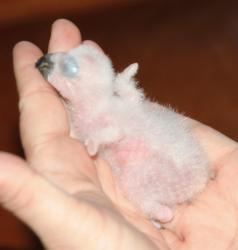
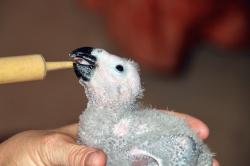
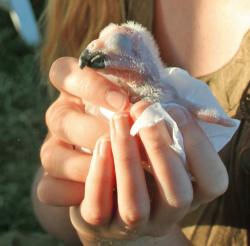
Photos in the Wings cast toward the sun...Icarus album of Badger Badger has a total of 122 photo album. You can view a list of the albums. The album is sorted by Date, click to sort by name. You are viewing the detailed list, click to switch to the brief one. This album contains 99 photos. Icarus - 1 day old
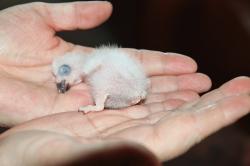
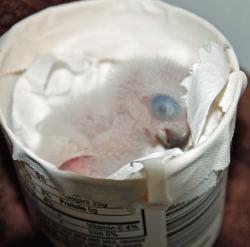
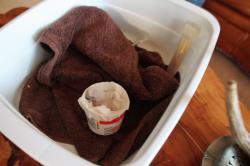 In Greek mythology, Icarus is the son of the master craftsman Daedalus. The main story told about Icarus in his attempt to escape from Crete by means of wings that his father constructed from feathers and wax. Thus named, this little abandoned infant African Gray. He almost didn't make it. 6 Aug 2011 at 4:19PM Icarus in his makeshift nest
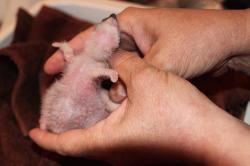
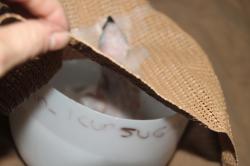
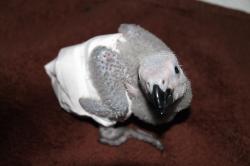
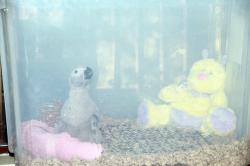
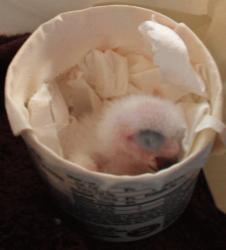 Hatched July 29th. A yogurt cup cut in half and lined with paper towel holds him nicely. Three rubber gloves filled with warm water (you just zap them to rewarm the water) are then wrapped around the half cup and covered with a washcloth to keep him warm while he sleeps. 13 Sep 2011 at 6:40PM Icarus lidded eyes
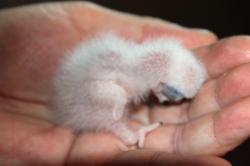
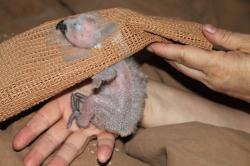
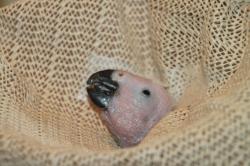
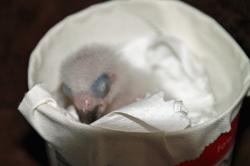 Parrot babies eyes are always lidded at first. After a week or so, they will begin to open. But there is no mistaking that he can still see you. Especially when it comes to food. 6 Aug 2011 at 4:25PM Hungry!
 Icarus wiggling about and peeping as he hears me get his breakfast ready. See his little eye beneath the lid? He can see movement and identify who you are well enough even though his lid is closed. 6 Aug 2011 at 4:28PM Egg tooth
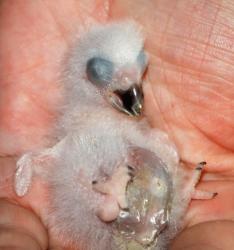
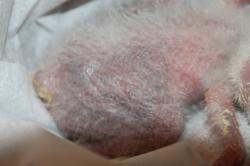
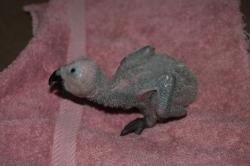
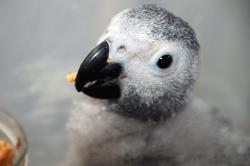
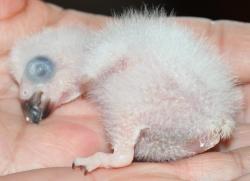 A newly hatched baby bird has a small pointed hardened process on the front portion of the upper beak, called the egg tooth. The egg tooth is used by the hatchling to pip into the air cell of the egg, and then to break and unzip the shell. It is then shed sometime after hatching. 6 Aug 2011 at 4:48PM Zygodactyl - toes and claws.
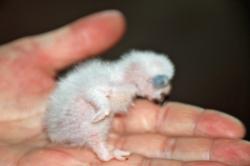
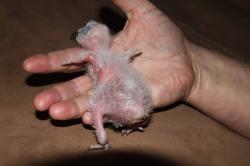
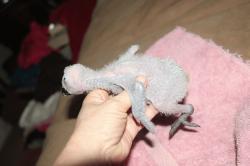
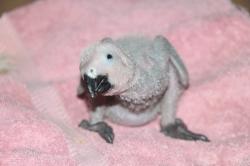
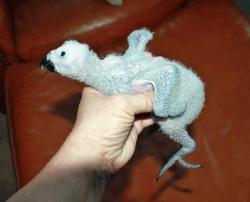
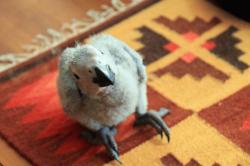
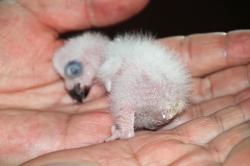 There are different parts of a parrot's foot. One part is the toes and claws. On each foot, there are 4 toes and 4 claws. Two toes are pointing forward, and two are pointing back. This is called zygodactyl (ZI-go-dak-tul). Zygodactyl feet is a way that all parrots are the same. This special type of feet helps parrots grip branches very well. Above the foot is the ankle. Birds' ankles are very unusual. When a bird walks, their ankle is turned backwards! 6 Aug 2011 at 4:39PM Icarus wing and zygodactyl
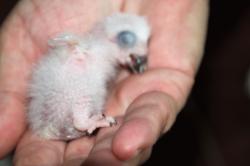 He is so cute! Especially his little feet. There are two common species of African grey parrots. Icarus is a Congo African Grey. The African Grey Parrot, also known as the Grey Parrot, is a medium-sized parrot found in the primary and secondary rainforest of West and Central Africa. Experts regard it as one of the most intelligent birds. They feed primarily on palm nuts, seeds, fruits, leafy matter, but have been observed eating snails. Their overall gentle nature and their inclination and ability to mimic speech have made them popular pets. 6 Aug 2011 at 4:41PM Little Brother
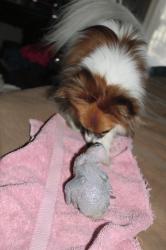
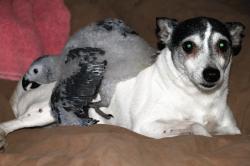
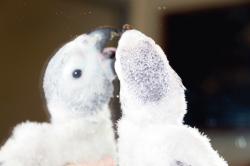
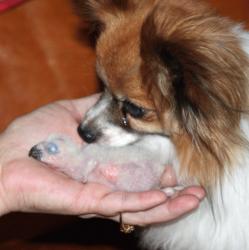 Cochise is completely smitten with Icarus! Every time I feed the baby, there is the little dog feeling rather large for a change, watching the birds every move. 15 Aug 2011 at 11:36PM Balding - my fault entirely!
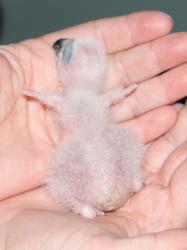 Accidentally spilling a little baby food on Icarus' head, I wet a cotton ball, and slightly dabbed the food off his head...but some of the down came right off with the food! 15 Aug 2011 at 11:44PM A Full Crop
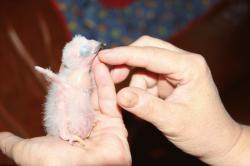 The Gullet is the tube in a birds throat which allows a birds food to pass down into it's "Crop" where it is ground down before passing into the birds stomach and alimentary tract, and then passes out the waste at the other end. You can tell when the crop is full by looking below the birds beak between it's breast bones, it will protrude from it's chest. You can see Icarus's full crop just under his neck in this photo. When I first started feeding him, he ate .03 CC's every hour on the hour. Today, at a week old, he eats 2.5 CC's every hour, except at night when he sleeps a straight four hours. Talk about worn out! Thank goodness this will only last a few short months. Honestly, I don't know how I handled all those sleepless years when my kids were but babies. 15 Aug 2011 at 11:34PM 3 CC's of gruel each feeding every two hours at two weeks of age
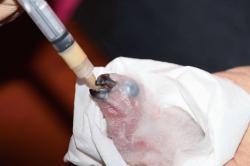 I am not getting much sleep, but having a great time. Kind of an oxymoron. 29 Aug 2011 at 8:32PM Nothing like being loved
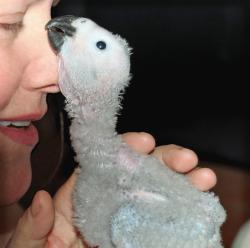
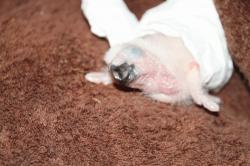 Where ever I go, this little bird struggles to keep me in his line of vision, cooing all the while. Really tugs at my heart strings!! 29 Aug 2011 at 8:34PM Keeping an eye on me
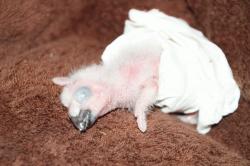 Notice how far down the beak the egg tooth now sits? That's how much he has grown! The little bit of beak exposed past the egg tooth is the same amount that extended past the egg tooth in the first pictures I posted.
29 Aug 2011 at 8:29PM The beginnings of feathers
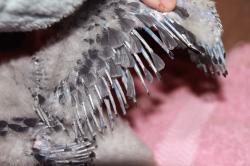
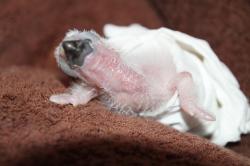 Look down alongside the bottom of Ickies neck and you will see the dark formations of pinfeathers. 29 Aug 2011 at 8:51PM Hand wing
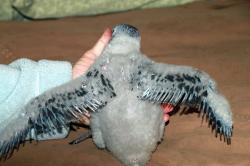
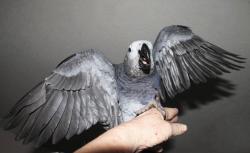
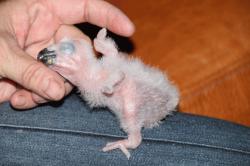 Birds have two-part wings. The proximal "arm wing" is rounded on front, humped on top, and sharp on the back -- just like most airplane wings. Further away, the "hand wing" is flatter on top and extremely sharp on the front. The hand wing is so named for it's thumb like protrusion and it's position at the end of the wing. 13 Sep 2011 at 6:48PM Covered in soft, white down
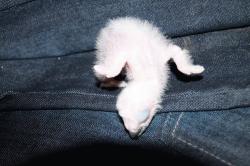 You can tell how small this little baby is by the size of the interwoven jean material and stitching on the exposed pocket. 13 Sep 2011 at 6:42PM First steps
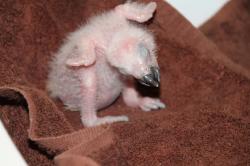 Parrot babies are fully dependent for 4 to 6 months. Here, Icarus is just beginning to walk (cooing for me as he does so), barely able to hold his head up. Look: You can see the beginning of eye slits on his lids. 29 Aug 2011 at 8:55PM Eyes almost open!
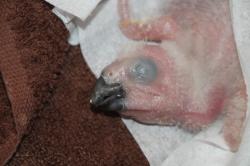 Icarus's eye lids are just developing eye slits while thickening so he can no longer see through them. Every now and then, it appears he is struggling to open them, but it's not time yet. 29 Aug 2011 at 9:17PM Eye lashes forming!
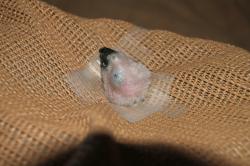 You see Icarus here, in a home made neck brace of sorts to help his weak neck as suggested by his avian vet. 29 Aug 2011 at 9:00PM Eyes open!
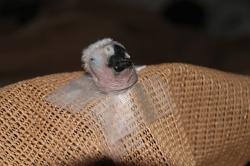 ...and what a mess on his face too after he finished his meal. Baby parrots are no less messy than human babies. 29 Aug 2011 at 9:02PM Full crop
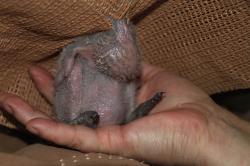 At four weeks old, Icarus's feathers are more developed, but not poking out of his skin just yet...he scratches at them constantly, so it must be an itchy experience. Have you noticed how big his feet are getting? 29 Aug 2011 at 9:04PM Ear vents
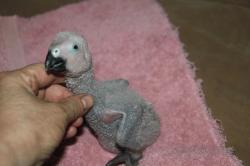 Ear vents are more defined now, and Ick can stand for brief periods of time. See that egg tooth? His feathers are just beginning to pop through with little tuffs on the ends. 29 Aug 2011 at 9:08PM Still following me where ever I go
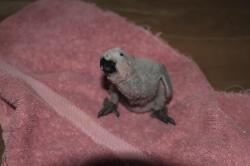 First word developing out of Icks constant cooing is "mamama" just like a human baby! 29 Aug 2011 at 9:10PM 30 CC's each feeding!
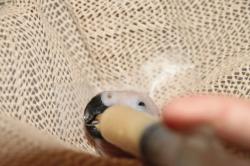 At least it isn't needed every hour now and I can sleep for up to three hours at a time during the night before demands for food reach my ears. 29 Aug 2011 at 9:11PM Bird tongues
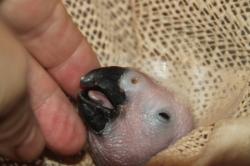 Parrots have dry tongues that feel kind of like a baby's finger (really small and stubby). Birds have dry tongues because they don't have any glands to salivate with. If they need to moisten their food, they dip it in water. 13 Sep 2011 at 6:36PM Living in a pitcher
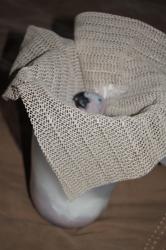 Ick still needs his neck brace, so when he goes to bed, this is how he does it, in a pitcher lined with TP (like any baby, you gotta keep his little bum clean) lol. 29 Aug 2011 at 9:16PM Massaging the crop
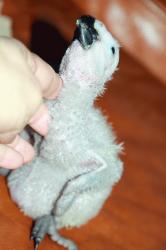 Icarus developed whats called "slow crop", a common parrot chick ailment. The treatment is a little applesauce in the formula and massaging of the gullet contents so they break down and pass through to the stomach, which is what you see me doing here. 13 Sep 2011 at 6:49PM The top of the gullet
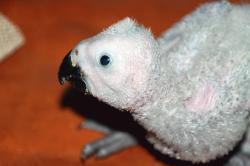 On the side of Ickies neck, is a pink featherless spot of skin. All parrots have two such spots (hard to see when fully feathered) at the back of their gullet, one on each side of the birds neck. 13 Sep 2011 at 1:45AM Brotherly love
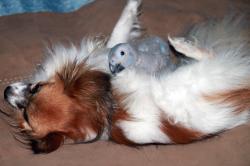
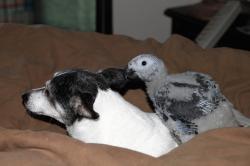
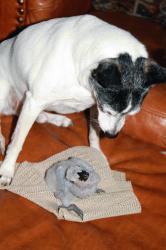 Banjo loves his little brother! Poor Ick would be nothing but a slobbery mess if I left the two together long because Banjo wants nothing more but to lick the poor little bird clean. 13 Sep 2011 at 1:47AM Gray down
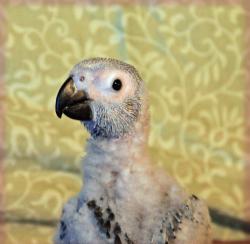
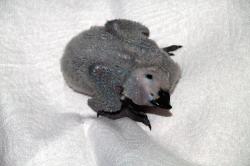 Ick is almost completely gray now, covered in the down of growing feather tufts. His skin has mostly turned a dark gray as well, giving him almost a purplish hue. If you look closely, on his elbows, you can see the beginnings of new feathers, with the tufts just beginning to poke out of the skin. 13 Sep 2011 at 1:58AM Watching mom work
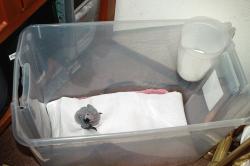 Icks homemade incubator with the pitcher he was sitting in when in the neck brace a few photo's ago. He is getting to large to wear the brace, and I am adjusting to the fact his little neck might always have a crook in it. 13 Sep 2011 at 2:02AM Cleaning up
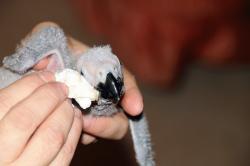 It is impossible to get it all as Ick struggles and complains like any child would when getting their face cleaned. 13 Sep 2011 at 2:05AM Look how large Ick has grown!
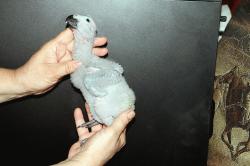 Far different bird than what he was a month ago! 13 Sep 2011 at 2:12AM Bird licks
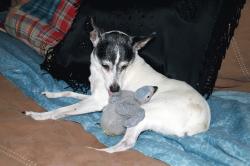 Banjo doesn't care to play. Despite his 12/13 years of age, he tenderly cares for every animal that needs tending; two day old kittens, baby birds, a squirrel that had been injured, the next door neighbors 130 lb elderly pitbull.... 13 Sep 2011 at 2:20AM That's it!
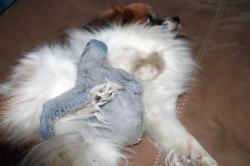 In the middle of playing together, Cochise suddenly realized he was losing! 13 Sep 2011 at 2:22AM Makes you smile, huh!
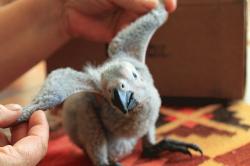 Who ever said birds don't have expressions was never owned by a bird! 14 Sep 2011 at 3:17PM Feathers!
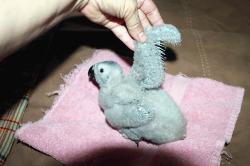 Baby birds have feathers that are soft and warm. They do not get feathers that allow them to fly, swim, and run like their parents until they are older. You see the Ick's adult feathers just developing here. Feathers are made of keratin. That’s the same stuff that makes up human hair and fingernails, reptile scales, and shells. Keratin also forms birds’ beaks and the scales and claws on their feet. 13 Sep 2011 at 2:26AM Beauty is in the eye of the beholder
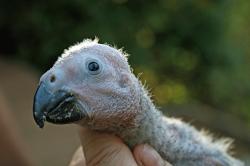 OK, I admit it, Ick does sorta of look like a naked turkey, but he is MY naked turkey!  13 Sep 2011 at 2:28AM Feather tracts
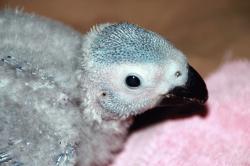 Feathers are not attached to birds in a random manner over the entire body of the bird. Instead they are usually found in often linear tracts celled pterylae. The spaces on the bird's body without feather tracts are referred to as apteria. The densest area for feathers is often on the bird's head and neck. You can see pterylae easily on Icks head, where the barbs are sticking out. 13 Sep 2011 at 4:00AM 12 ounces!
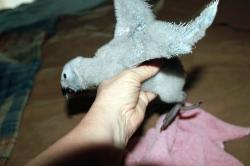 Ick weighed less than 1/2 an ounce when first hatched. Today, a whopping 12 ounces! 13 Sep 2011 at 4:01AM What big feet you have!
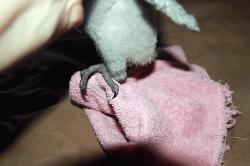 Ick's claws are fully hard now, so I have to be a little careful when handling to make sure I don't end up with holes on my arms. Parrot chicks don't know how to grasp right away, and discover their feet much like human children discover their hands. Ick is almost there. 13 Sep 2011 at 4:05AM Trying to cling to me
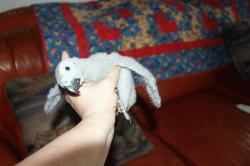 I am always amazed how similar parrot chicks are to human babies! 13 Sep 2011 at 4:07AM Sheer joy!
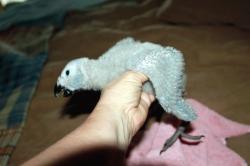 Ick loves to practice his wings. The expression on his face says it all! 13 Sep 2011 at 4:08AM Wing Feathers developing
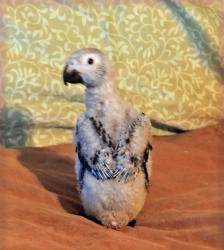 The tiny tops of tail feathers are beginning to show too. 7 Oct 2011 at 9:33PM First Solid Foods
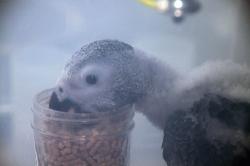 Ick won't be eating entirely on his own for a few months yet, but this is a nice start! 7 Oct 2011 at 9:38PM All Babies Need a Baby of Their Own!
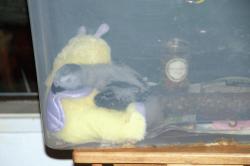
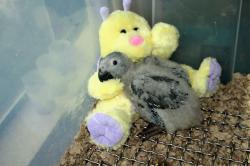 Ick loves his stuffed animals, and commonly sleeps on them when he isn't busy tasting their fur. 7 Oct 2011 at 9:39PM Play Time With Cochise - They appear to both be saying "Hide, here comes the cat!"
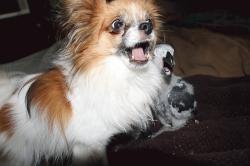 I have to watch it when these two play, as Cochise tends to get extra rough. But note Icks beak....he is no sissy lala! 1 Mar 2012 at 11:44PM Yum!
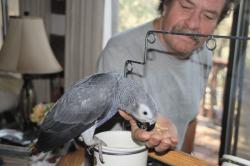 I am beginning to think Ick is an female lol...here I fed him every hour on the hour, 24/7 for that first month, as he graduated to every two hour feedings during the second month, on down to three and then four hour feedings as he turned three months. No matter. The bird is in love with my boyfriend Scott, not from me!  Such is life lol. Such is life lol. 2 Nov 2011 at 1:45AM 3 Months Old & Fully Feathered!
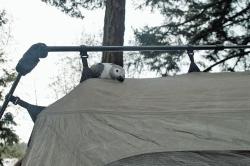
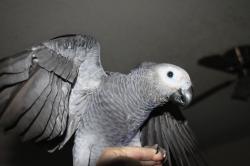 It has been a month since our trip up north, when Ick still wore his gray downy feathers. Today at three months of age, Ick is fully feathered, has an almost purple hue and weighs just over a full pound. You would only know he is still a chick by his immature chirp/cry and need to be fed. 2 Nov 2011 at 12:12AM First Flight
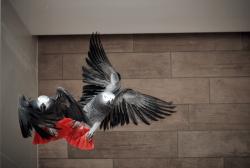
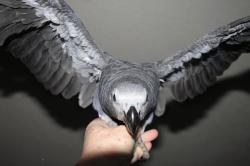 Learning to land will eventually come. Meanwhile, my poor hands, arms, neck, back, and face all wear the battle scars of birdly motherhood. I tried clipping and filing down his claws, but amid squawks and loud screeches, he let sure me know he wasn't having anything to do with it! 2 Nov 2011 at 12:18AM Sharing Dinner
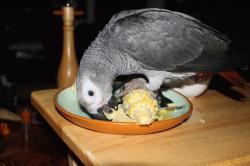 Ick loves to share my dinner with me...sometimes I even get to eat! 3 Nov 2011 at 10:16PM Training
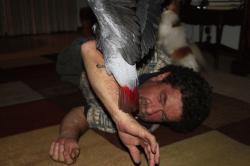
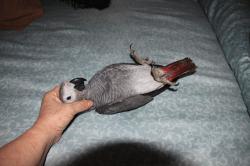 In order to file down Ick's toenails, and clip his wings (for the sake of my arms), he has to learn to lay on his back. Ick is already used to being handled all over his body, but that doesn't make laying on his back come easy. It's a very unnatural and unsafe position for birds. At first, he would flip himself back as soon as I let go, before finally learning that a little patience, and I would turn him back over. 3 Nov 2011 at 10:25PM Waiting
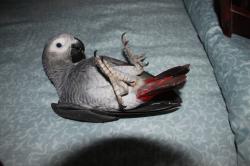 It only took a few tries, and there he was, waiting to see what I wanted. 3 Nov 2011 at 10:26PM Wing Trimming
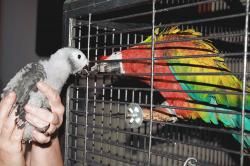
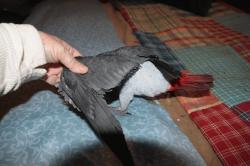 A bird that can fly is far more confidant than a bird that can't. Ick had only been flying for two days, but it was getting out of hand. The silly bird was flying into the windows when I wanted to put him away and chasing me around the house once he discovered he could force me to hold him 24/7 simply by landing on me, flying right back when placed on his perch lol. It's partly why my arms and wrists became so shredded. Not good For those feeling pity for stripping our feathered companions of their unique and beautiful flying abilities, fear not. All of my birds can fly and do so without flying off into the wild blue yonder. It's more a matter of training. The idea is not to take away Ick's flight abilities entirely, but to gain a little control over his new found freedom before he hurts himself (or me) in the process. I don't trim the outside primary flight feathers on purpose, because that would remove his ability to fly entirely. Rather, trimming the uplift secondary flight feathers on the inside of his wing enable him to still fly, but he can only go for short distances, semi low to the ground. No uplift! This will give him a chance to learn safe landing skills, what is allowed and what isn't and save my poor beat up arms in the process. Clipping the wings in this manner can be as painless as cutting hair. Usually, the bird has more objection to the restraint involved than the actual wing trimming. The good news is, Ick didn't have to be restrained. He quickly learned to lay on his back and patiently wait to be released, as seen in the prior photos, just before his wings were trimmed. 3 Nov 2011 at 10:58PM Pretty Bird!
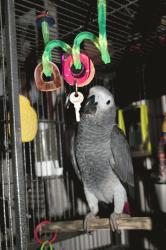
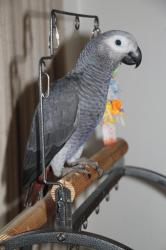
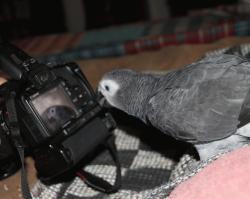 Raising a bird is a lot of work but a rewarding and fun experience too. Who would have guessed a bird could be so personable! Ick is four months old now, and almost fully mature. We sent in the DNA test kit this week to determine if Ick is male or female....if female, Icks name will change to Chantilly.  What's your guess, male, or female? What's your guess, male, or female?30 Nov 2011 at 11:27PM Hair Fun
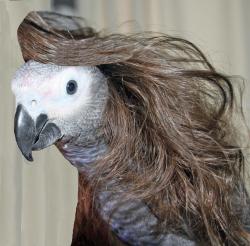 Ick loves to hide under my hair. The picture looks so silly after cropping out my face, giving Ick a bit of a "Conan O'brian" colic lol. 30 Nov 2011 at 11:41PM Isn't he lovely ♪ ♫ ♩ ♬
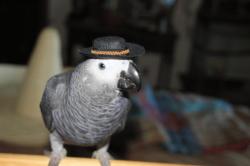
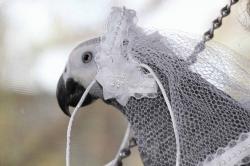  to the creative talents and thoughtful generosity of Scrapbooking Maven, Ick get's to play a bride this week. to the creative talents and thoughtful generosity of Scrapbooking Maven, Ick get's to play a bride this week.  Molly!! Molly!!  It's beautiful! It's beautiful!7 Feb 2012 at 9:26PM Remember when...
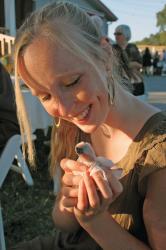 Hard to believe Ick was once so little! Here he is, about two/three weeks old. 15 Feb 2012 at 3:03AM |
©2000-2026 GoldToken.com LLC. All rights reserved. |