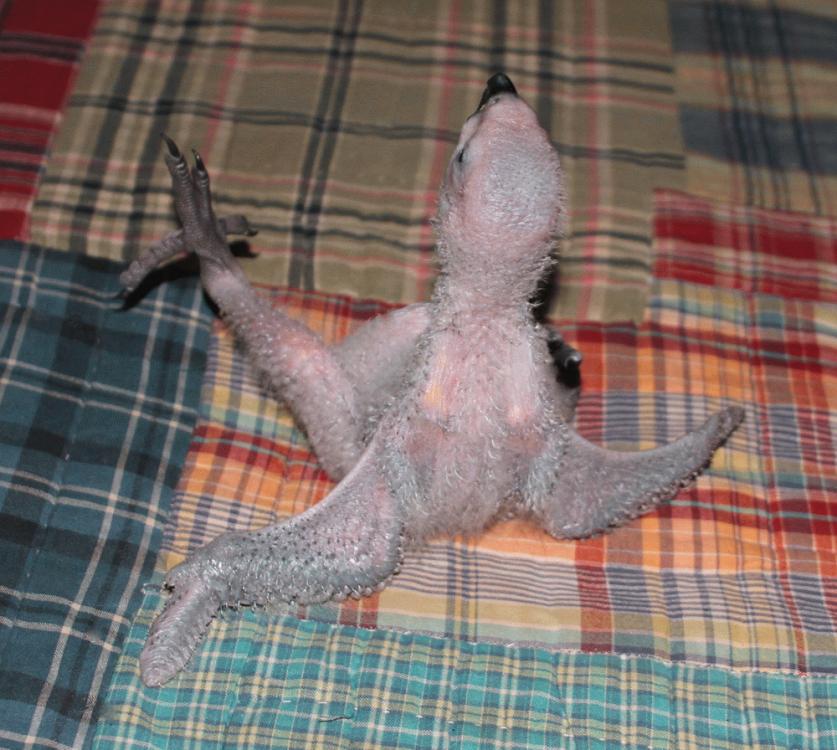
Up-righting Himself
To properly train a parrot, your goal is to ensure a very handle-able bird. It is easiest on them if you start doing things with them when still very young. Here, Davi was gently laid on his back and then allowed to quickly right himself. The lack of restraint in this process builds his confidence that being handled in odd ways is no big deal, laying the groundwork for future tricks he will learn. This is a good photo to explain some of Davi's anatomy. See his winghand? You can see what it is by the protruding "thumb". Just before that, his wrist is fused with the hand to form a single unit. This is because movement in a birds wing is sacrificed for flight stability. Only a few finger digits remain in a birds winghand, with the alula (what that bone is called in avian terms) representing the remnant of the thumb. Near Davi's shoulder is his clavicular air sac. With Davi's feathers growning in so fast, it won't be long before this part of his features are no longer view-able. This picture is included in the If you love life, life will love you back - Davinci photo album belonging to Badger. It has been uploaded on 12 Jul 2012 at 10:31PM. Votes: 0 You can return to Badger's album or open your photo album. Comments Re: Up-righting Himself I have had parrots before but did not hand raise them, thank you for the education about things I never would have thought about.
Posted at 13 Jul 2012 at 6:50PM by agony of deFeet Re: Up-righting Himself What kind of parrots did you have Nancy? You can successfully train an adult parrot that's never been handled, but it does take longer and requires a lot more patience resulting in a few bites in the process. I got Mariah (the big red macaw), when she was 15 years old and wild as a jaybird. It took a month of climbing into her cage every day before she wouldn't growl at me for getting too close and then months of hand feeding her favorite seeds before she would get up on my arm. My arms and hands were so torn up in the process (you can't flinch when a bird bites you or it will encourage them to bite again, as your flinch is seen as a consequential retreat from them, which is a reward for their having bit you). I tried clicker training, which is supposed to be 100% effective but the clicker terrified her lol. Today, four years later, she is very friendly, likes her head scratched and often tries to feed me. She still occasionally bites and will try and take a chunk out of strangers if they get too close. However, she now does a few tricks, has developed a nice vocabulary of words and I can run my fingers through her feathers. Posted at 13 Jul 2012 at 10:41PM by Badger (You must be logged in to post comments) |
©2000-2026 GoldToken.com LLC. All rights reserved. |